48V LiFePO4 Battery and Inverter: How an All-in-One Solar Storage System Works
Aug 29,2026 | TezePower
48V LiFePO4 Battery and Inverter: How an All-in-One Solar Storage System Works
As residential solar energy storage becomes more accessible, homeowners are looking for battery systems that can store solar power efficiently, provide reliable backup electricity, and reduce dependence on the utility grid.
One of the most practical solutions for home energy storage is a 48V LiFePO4 battery combined with a hybrid inverter.
Compared with traditional systems that require a separate battery bank, inverter, charger, and multiple communication components, an all-in-one LiFePO4 energy storage system integrates the major components into one system. This can simplify installation, improve system coordination, and make solar energy storage easier to manage.
But what exactly is a 48V LiFePO4 battery? How does it work with an inverter? And is a 48V battery suitable for solar storage, backup power, or off-grid applications?
This guide explains the key points you need to know before choosing a 48V LiFePO4 battery and inverter system.
What Is a 48V LiFePO4 Battery?
A 48V LiFePO4 battery is a rechargeable lithium iron phosphate energy storage battery designed around a nominal voltage of approximately 48V.
LiFePO4, or lithium iron phosphate, is widely used in energy storage because it offers a combination of long cycle life, good thermal stability, high usable energy, and relatively low maintenance requirements.
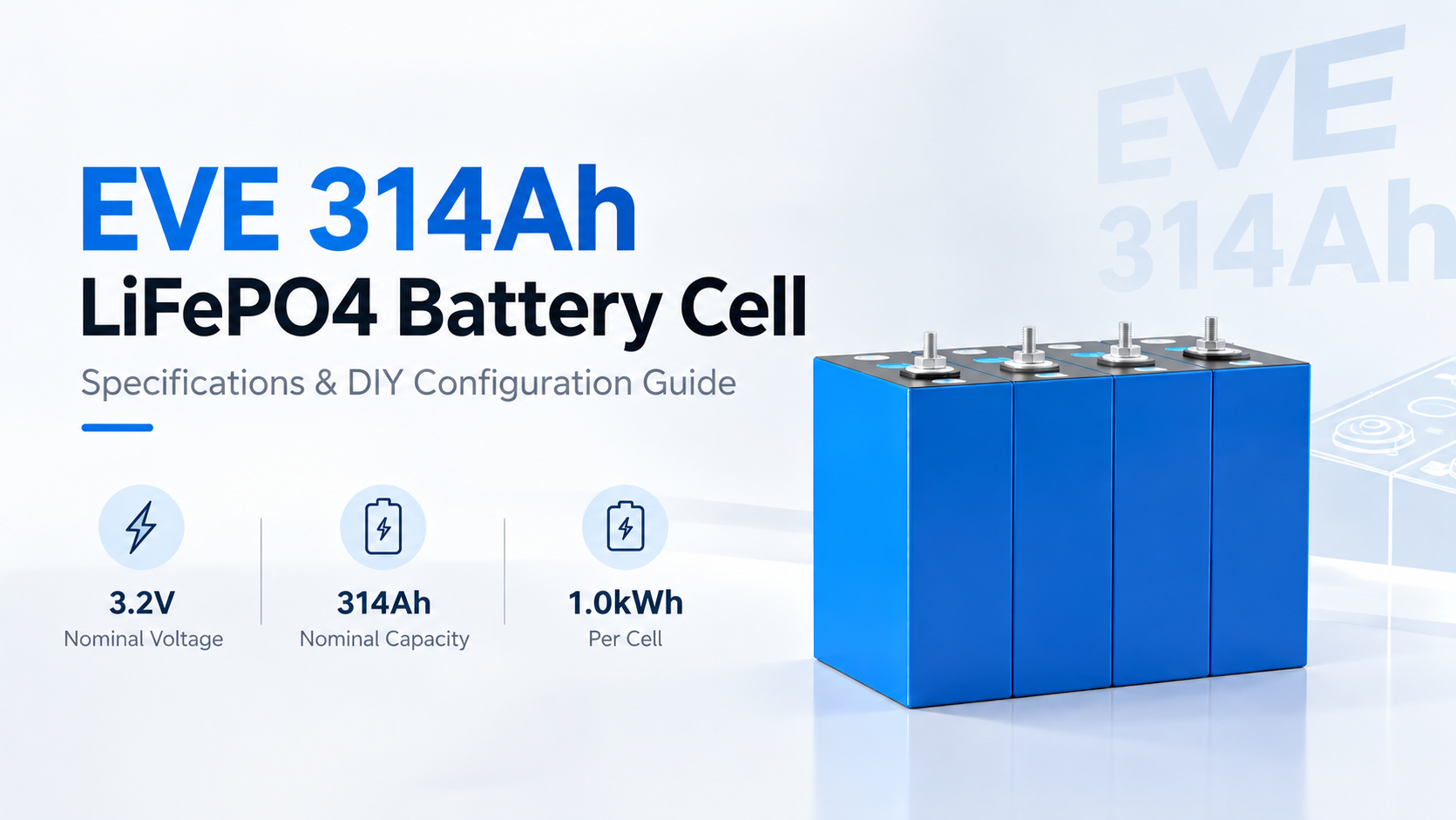
In practical solar storage systems, you may also see 51.2V LiFePO4 batteries. A 51.2V battery is typically built using 16 LiFePO4 cells connected in series, while a conventional 48V configuration can use a different series arrangement depending on the battery design.
For this reason, the terms "48V battery" and "51.2V battery" are often seen together in the residential energy storage market.
The important factors are not only the nominal voltage, but also:
-
Battery capacity in Ah
-
Total energy capacity in kWh
-
Maximum charge current
-
Maximum discharge current
-
Depth of discharge (DOD)
-
Cycle life
-
Battery management system (BMS)
-
Inverter compatibility
-
Communication protocols
-
Installation environment
Why Is LiFePO4 Popular for Solar Energy Storage?
Solar panels generate electricity during the day, but household electricity demand does not always match solar production.
For example, a home may generate the most solar energy around noon while consuming more electricity in the evening.
A battery energy storage system solves this mismatch by storing excess solar energy and making it available later.
LiFePO4 batteries are particularly suitable for this application because they are designed for repeated charge and discharge cycles.
1. Long Cycle Life
Solar storage batteries may be charged and discharged frequently throughout their service life.
A quality LiFePO4 battery can provide thousands of cycles when operated within its specified conditions.
For example, TezePower's current 16kWh All-in-One ESS is specified at more than 10,000 cycles under its stated test conditions for the JK BMS version. Actual service life depends on operating temperature, charge/discharge rate, depth of discharge, installation, and other conditions.
2. High Energy Density
LiFePO4 technology can provide substantial energy storage in a relatively compact battery system.
This makes it useful for:
-
Residential solar storage
-
Backup power
-
Off-grid homes
-
Cabins and remote properties
-
Small commercial energy storage
-
Self-consumption solar systems
3. Stable Battery Chemistry
LiFePO4 chemistry is widely selected for stationary energy storage because of its strong thermal and chemical stability compared with some other lithium battery chemistries.
A properly designed battery system should also include a battery management system and appropriate electrical and thermal protection.
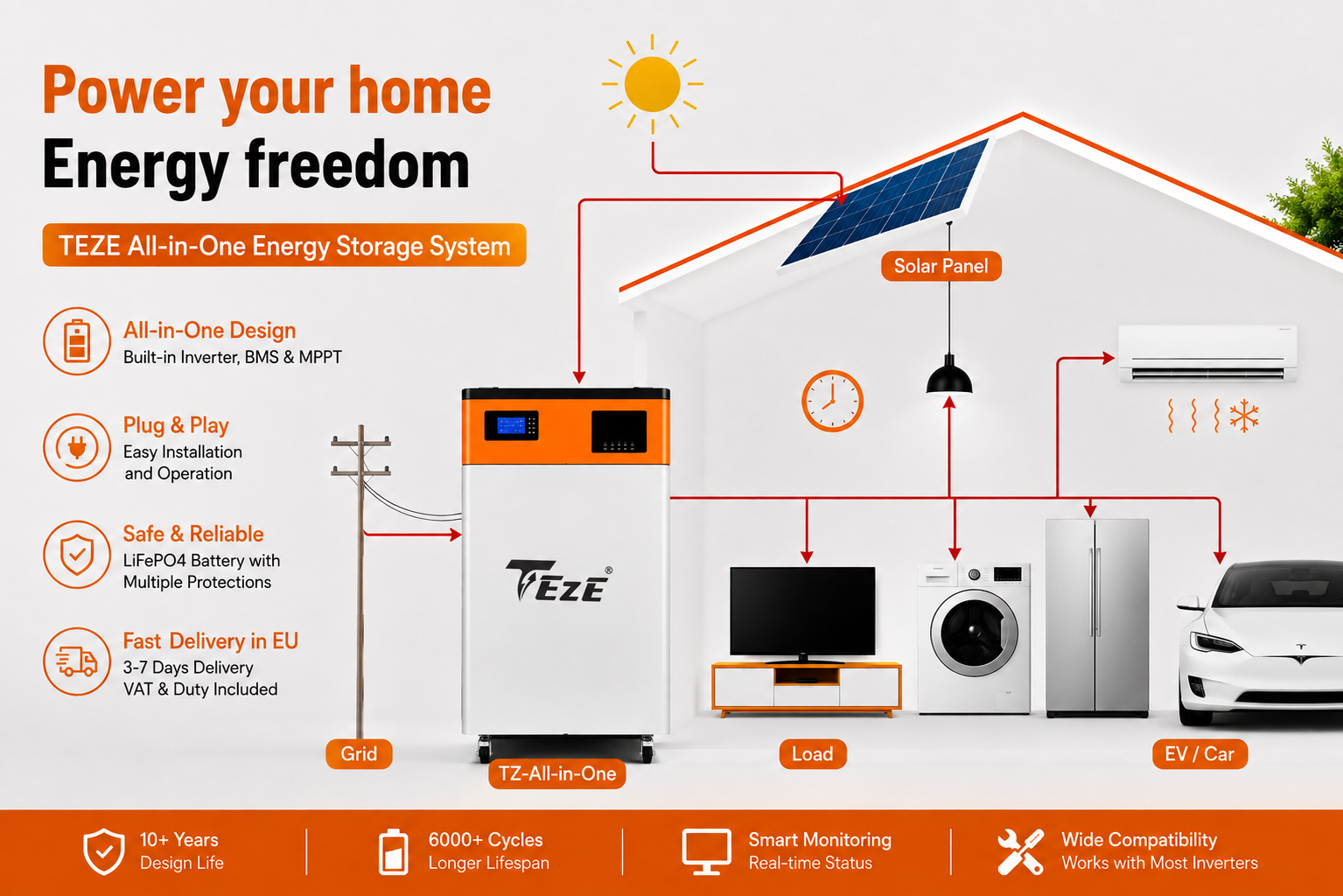
How Does a 48V LiFePO4 Battery Work With a Solar Inverter?
A solar energy storage system typically involves several energy sources and loads:
Solar Panels → Hybrid Inverter → Home Loads
and
Solar Panels → Hybrid Inverter → LiFePO4 Battery
When solar production exceeds household consumption, the system can direct surplus energy toward battery charging.
When solar production decreases, the stored battery energy can be converted by the inverter into AC electricity for household loads.
A hybrid inverter coordinates these energy flows.
Depending on the system configuration, electricity can come from:
-
Solar panels
-
Battery storage
-
Utility grid
-
Backup generator
This allows the system to automatically manage energy according to the selected operating mode.
What Is a 48V All-in-One Solar Battery?
A traditional solar energy storage system may require several independent components:
-
LiFePO4 battery
-
Hybrid inverter
-
MPPT solar charger
-
Battery management system
-
Communication equipment
-
Protection components
-
Wiring and connections
An all-in-one solar battery combines several of these functions into a single integrated system.
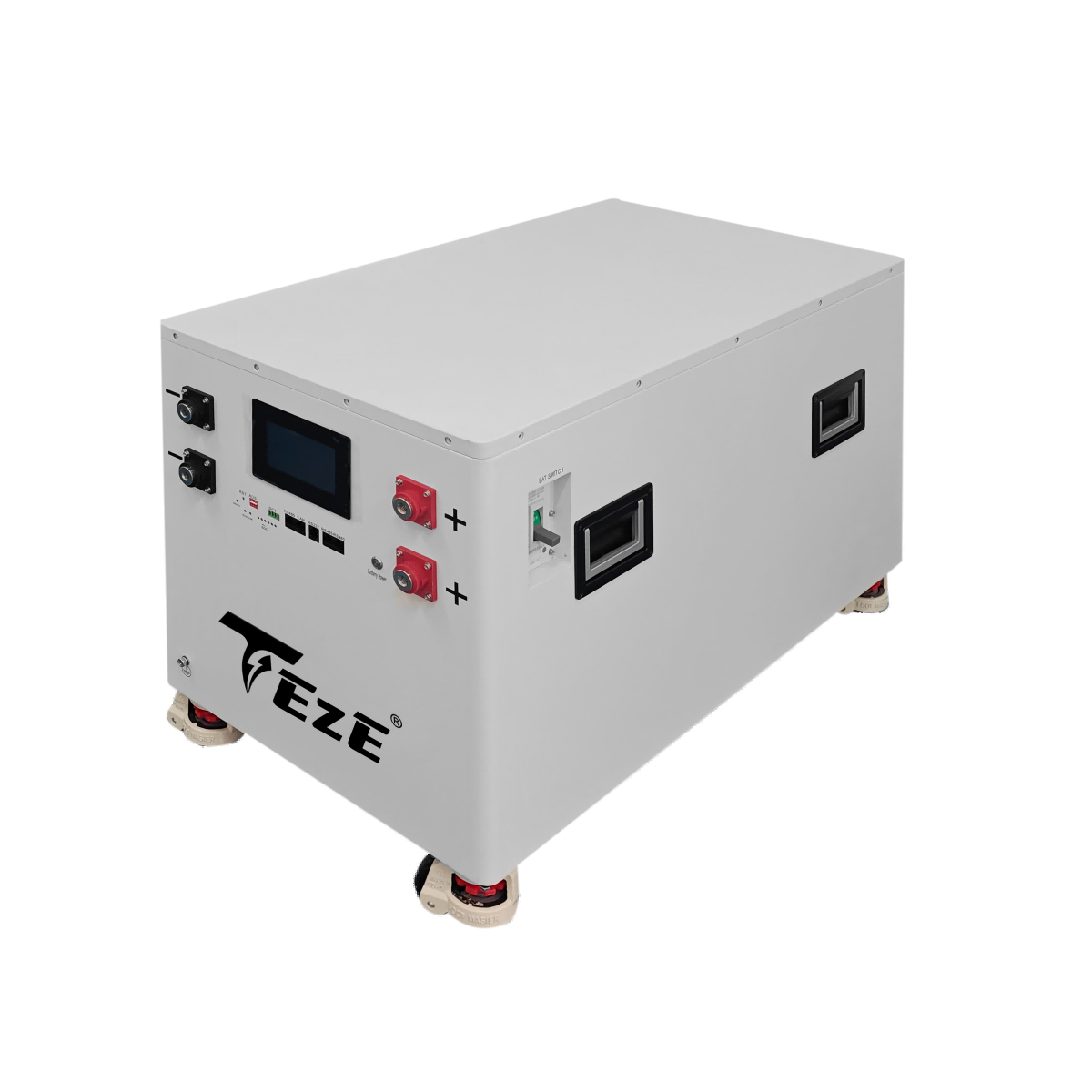
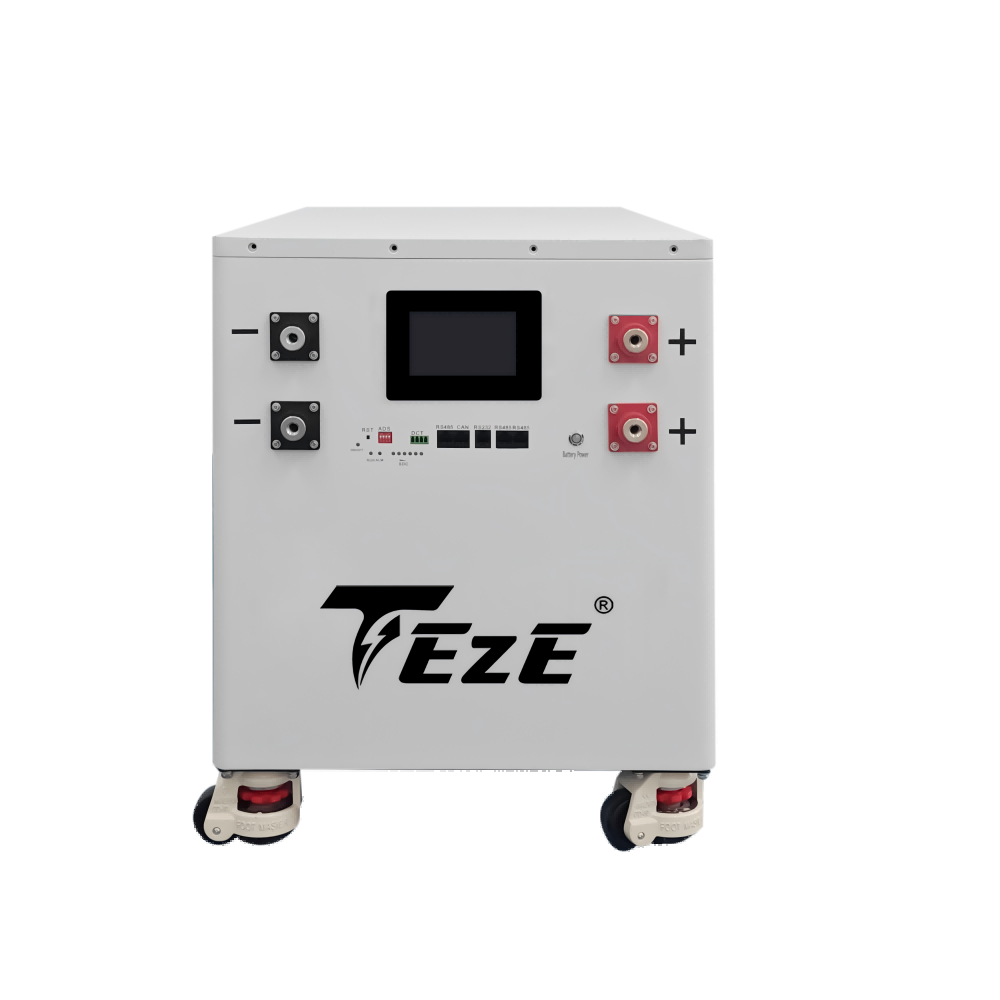
For example, TezePower's current 16kWh All-in-One ESS combines a 51.2V LiFePO4 battery, built-in 5kW hybrid inverter, and smart BMS in one system. The system supports solar charging, grid charging, battery backup, and remote monitoring options.
This approach can reduce the number of separate components that need to be selected and connected.
What Are the Advantages of a LiFePO4 Battery With a Built-in Inverter?
1. Simpler System Design
With a conventional battery-plus-inverter system, the battery and inverter need to be selected for electrical compatibility.
An integrated system is designed as a complete energy storage solution, reducing the complexity of component matching.
2. Easier Installation
An all-in-one system can simplify installation because major components are already integrated.
However, electrical installation should still follow local regulations and manufacturer instructions. Qualified solar or electrical professionals should be used where required.
3. Better Component Coordination
The battery, inverter, BMS, and communication system are designed to work together.
This can simplify:
-
Battery charging
-
Discharge control
-
Protection
-
Energy management
-
System monitoring
4. Less Equipment Around the Installation Area
Instead of mounting a separate battery bank and inverter, an integrated energy storage system can consolidate major components into one enclosure.
This can be particularly useful for homes where installation space is limited.
How Much Energy Can a 48V Battery Store?
Battery energy is generally calculated using:
Energy (Wh) = Voltage (V) × Capacity (Ah)
For example:
51.2V × 314Ah ≈ 16,077Wh
or approximately:
16.1kWh
This is why a 51.2V 314Ah battery is commonly marketed as a 16kWh LiFePO4 battery.
A system's actual usable energy can be lower than its nominal battery capacity depending on the configured depth of discharge, inverter losses, battery protection limits, operating temperature, and other system conditions.
How Long Can a 48V LiFePO4 Battery Power a Home?
There is no single answer because energy consumption varies significantly from home to home.
The basic calculation is:
Runtime ≈ Usable Battery Energy ÷ Average Load Power
For example, if a battery provides approximately 16kWh of usable energy and the average household load is 1kW:
16kWh ÷ 1kW ≈ 16 hours
If the average load increases to 2kW:
16kWh ÷ 2kW ≈ 8 hours
These are simplified estimates. Real-world runtime will be affected by inverter efficiency, battery operating limits, temperature, load fluctuations, and other factors.
High-power appliances such as air conditioners, electric heaters, water heaters, pumps, and induction cookers can significantly increase energy consumption.
What Size Inverter Should You Use With a 48V LiFePO4 Battery?
Choosing an inverter is not simply a matter of matching the battery voltage.
You also need to consider:
-
Continuous output power
-
Peak/surge power
-
Maximum battery discharge current
-
Solar PV input power
-
MPPT voltage range
-
AC voltage and frequency
-
Communication compatibility
-
Required backup loads
For example, a 5kW hybrid inverter can provide up to 5,000W of rated output under its specified operating conditions.
TezePower's current 16kWh All-in-One ESS uses a built-in 5kW inverter with a 10kVA peak output specification and supports PV input up to 7,500W, depending on the selected model and configuration.
The inverter should always be selected according to the battery's maximum charge/discharge specifications and the actual electrical loads.
48V vs. 51.2V LiFePO4 Battery: What's the Difference?
One common question is:
Is a 51.2V battery still a 48V battery?
In the energy storage market, the answer is often yes in terms of system category.
A "48V battery" is frequently used as a general market term for low-voltage battery systems around the 48V class.
A 51.2V LiFePO4 battery typically uses 16 cells in series:
3.2V × 16 = 51.2V nominal
The actual voltage varies depending on the battery's state of charge and operating conditions.
Therefore, when comparing products, it is more important to check the manufacturer's actual voltage range and inverter compatibility rather than relying only on the "48V" label.
How Does the BMS Protect a LiFePO4 Battery?
The Battery Management System (BMS) is one of the most important parts of a lithium battery.
A BMS continuously monitors battery operating conditions and helps protect the battery from abnormal conditions such as:
-
Overcharging
-
Over-discharging
-
Excessive current
-
Short circuits
-
Abnormal temperatures
-
Cell voltage imbalance
Advanced BMS designs can also provide communication between the battery and inverter.
For example, current TezePower All-in-One models can support communication interfaces such as RS485, CAN, and Wi-Fi, depending on the model and configuration.
Some configurations also support active cell balancing, which can help maintain cell consistency over long-term operation.
Can a 48V LiFePO4 Battery Be Used Off-Grid?
Yes.
A properly configured 48V-class LiFePO4 battery can be used in off-grid solar systems where there is limited or no access to utility electricity.
A typical off-grid system may include:
Solar Panels → Hybrid Inverter → LiFePO4 Battery → Household Loads
During sunny periods, solar energy can supply the loads and charge the battery.
At night or during periods of low solar production, the battery can provide stored energy.
For remote cabins, workshops, RVs, backup systems, and off-grid homes, this configuration can provide a practical alternative to relying entirely on a generator.
Can a 48V Battery Provide Backup Power During a Grid Outage?
A suitable hybrid inverter and battery system can provide backup power when the utility grid fails.
During normal operation, the system may use solar power, grid power, and battery storage according to its configured energy management strategy.
During a power outage, the inverter can switch to battery operation and continue supplying supported loads.
However, not every inverter automatically provides backup power, and the backup capability depends on the inverter design, wiring configuration, transfer characteristics, and local electrical requirements.
Before purchasing a system, always confirm whether it supports the type of backup operation you need.
Why Choose an All-in-One LiFePO4 ESS for Home Solar Storage?
For homeowners who want a simpler energy storage solution, an all-in-one system can offer several advantages.
Integrated Battery + Inverter
The battery and inverter are combined into one energy storage system, reducing the number of separate components.
Solar + Grid Charging
Depending on the inverter configuration, the system can support solar charging, grid charging, or both.
Intelligent Energy Management
The inverter can coordinate energy from solar panels, the battery, the grid, and household loads.
Remote Monitoring
Supported configurations can provide Bluetooth or Wi-Fi monitoring, allowing users to check battery and system operating information through compatible applications.
Expandable Energy Storage
Some systems can be connected in parallel to increase storage capacity or output power, provided that the models and system architecture support parallel operation.
For example, TezePower's current 16kWh All-in-One ESS supports parallel expansion with compatible identical units, with the manufacturer's product documentation specifying the supported configuration.
What Should You Check Before Buying a 48V LiFePO4 Solar Battery?
Before purchasing a battery, don't focus only on the advertised kWh capacity.
Check these specifications carefully:
Battery Capacity
Compare the nominal and usable energy capacity.
Battery Voltage
Confirm whether the system is 48V, 51.2V, or another voltage class.
Inverter Power
Make sure the inverter can handle your continuous and peak loads.
Maximum Charge and Discharge Current
The battery's current rating must be compatible with the inverter.
Cycle Life
Check the test conditions behind the advertised cycle number, including DOD, charge/discharge rate, and temperature.
BMS
Look for appropriate protection functions and communication compatibility.
Solar Input
Check the inverter's maximum PV input power, voltage range, and current.
Communication
Confirm whether the battery and inverter support CAN, RS485, Wi-Fi, Bluetooth, or other required protocols.
Installation Environment
Check operating temperature, humidity, IP rating, cooling method, and whether the system is intended for indoor or outdoor installation.
48V LiFePO4 Battery vs. Traditional Lead-Acid Battery
LiFePO4 batteries and lead-acid batteries can both be used for energy storage, but they have different characteristics.
| Feature | LiFePO4 | Lead-Acid |
|---|---|---|
| Cycle life | Generally much longer | Generally shorter |
| Usable depth of discharge | Generally higher | Generally lower |
| Weight | Lower for comparable energy | Higher |
| Maintenance | Low | Can require more maintenance |
| Energy density | Higher | Lower |
| Solar storage suitability | Excellent | Suitable for some applications |
| Long-term energy storage | Strong option | More limited |
For frequently cycled solar energy storage, LiFePO4 is often attractive because the battery can be repeatedly charged and discharged over a long service life.
Is a 48V LiFePO4 All-in-One Battery Worth It?
For homeowners, off-grid users, and backup power customers who want to simplify their solar storage system, a 48V-class LiFePO4 All-in-One ESS can be an attractive solution.
Instead of purchasing and integrating multiple independent components, an all-in-one system combines the battery, inverter, BMS, and related energy management functions into a coordinated platform.
For example, the TezePower 16kWh All-in-One ESS combines a 51.2V 314Ah LiFePO4 battery with a built-in 5kW hybrid inverter and Smart JK BMS. The current model is designed for residential solar storage, backup power, self-consumption, and off-grid applications.
The system also supports optional Wi-Fi monitoring and an optional heating configuration, depending on the selected version.
Frequently Asked Questions
Is 48V LiFePO4 good for solar?
Yes. 48V-class LiFePO4 batteries are widely used in residential solar energy storage, backup power, and off-grid systems. Their long cycle life, high usable energy, and compatibility with hybrid inverters make them suitable for frequent energy cycling.
Is 51.2V the same as 48V?
51.2V is commonly considered part of the 48V-class battery category. A typical 51.2V LiFePO4 battery uses 16 cells connected in series, with each cell having a nominal voltage of approximately 3.2V.
Can I connect a LiFePO4 battery directly to a solar panel?
In most residential systems, a solar panel should not be connected directly to a LiFePO4 battery. A compatible solar charge controller or hybrid inverter is normally required to regulate charging voltage and current.
Can I use a 5kW inverter with a 48V battery?
Yes, provided the battery's voltage range, maximum discharge current, BMS, and communication system are compatible with the inverter. The battery must also be capable of supplying the required power.
How many batteries do I need for a home?
The answer depends on your daily electricity consumption, backup requirements, solar production, and desired autonomy.
For example, a home using 10kWh of electricity per day will have very different storage requirements from a home consuming 30kWh per day.
A simple starting point is:
Required Battery Capacity ≈ Daily Energy Consumption × Desired Backup Days
The final system should then account for usable DOD, inverter efficiency, seasonal solar production, and load characteristics.
Conclusion: Choosing the Right 48V LiFePO4 Battery for Solar Storage
A 48V LiFePO4 battery is more than simply a rechargeable battery. When combined with a compatible hybrid inverter, BMS, solar input, and monitoring system, it becomes the foundation of a complete residential energy storage solution.
For homeowners, the most important factors are not simply the largest battery capacity or the highest advertised cycle number.
Instead, look at the entire system:
Battery capacity + inverter power + BMS + solar input + compatibility + safety + monitoring + scalability
An integrated All-in-One ESS can make this process easier by combining these major functions into one coordinated system.
For users looking for a compact residential solar storage solution, TezePower's 16kWh All-in-One ESS combines a 51.2V 314Ah LiFePO4 battery, built-in 5kW hybrid inverter, and Smart BMS in a single system, with optional Wi-Fi monitoring and heating configurations.
If you are planning a home solar battery system, backup power solution, or off-grid energy system, choosing the battery and inverter as one coordinated system can be a practical way to simplify system design and improve long-term energy management.
Explore TezePower's 48V / 51.2V LiFePO4 energy storage solutions to find the right battery capacity and inverter configuration for your application.
👉 Click here to learn more about our 15kWh All in One Battery and order now!
Commento